Design for Manufacturing in Machining: How Smart Engineering Reduces Cost, Lead Time, and Risk
When a product moves from concept to production, machining is often one of the first manufacturing processes involved. Whether it’s prototype parts, tooling, fixtures, or production components, machined parts are everywhere in product development.
But machining efficiency isn’t determined at the machine. It’s determined in the design.
This is where Design for Manufacturing (DFM) becomes critical. Small decisions in CAD can dramatically impact machining time, tool wear, setup complexity, and ultimately the cost and success of a product.
At Forge Product Development, we work closely with our clients to bridge the gap between design intent and manufacturing reality. A well-designed part doesn’t just meet functional requirements. It respects the tools, the processes, and the shop floor realities that will bring it to life.
Here are several principles we use when designing machined parts for manufacturability.
Use Standard Tools and Sizes
One of the most common mistakes in machined part design is specifying geometry that requires unusual or specialty tooling.
Shops operate most efficiently when they can rely on their standard tool libraries. Designing parts that use common endmills, drills, reamers, and taps allows manufacturers to cut parts faster and more predictably. Even something as simple as keeping in mind whether the shop will be using inch or metric tools can make a big difference.
Whenever possible, designers should size holes, radii, and features so they can be cut with the same tools throughout the part. This keeps the tool list small and reduces tool changes, which directly lowers machining time.
Another practical approach is to ask the manufacturing partner for their tool list. Designing around the tools a shop already has can simplify production dramatically.
Avoid Geometry That Fights the Process
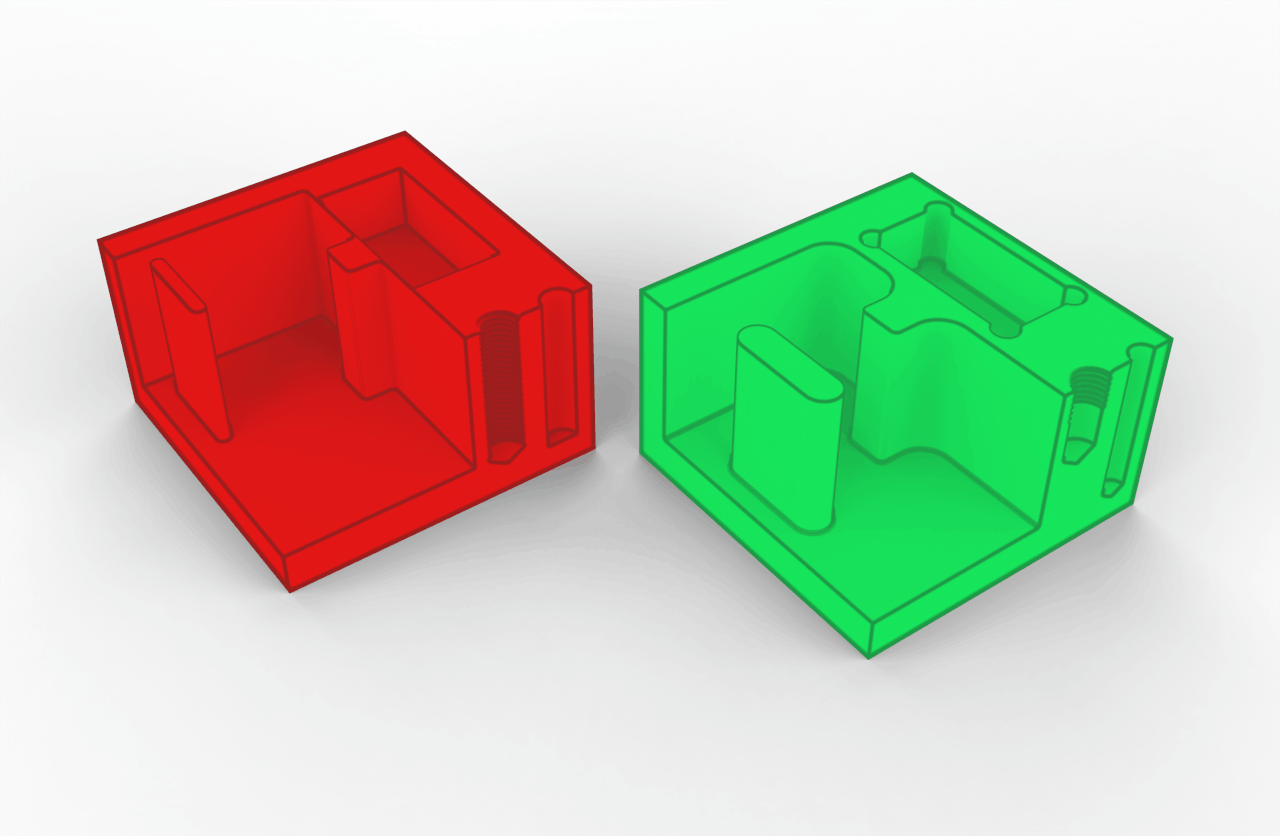
Machining tools work best when they are rigid and well supported. Designs that require tools to reach deep into pockets or narrow cavities increase vibration, reduce tool life, and slow down machining.
As a rule of thumb, cavity depth should generally stay below three times the tool diameter. This means internal radii should ideally be greater than 1/6 the tool diameter.
Similarly, hole depth should typically remain under six times the drill diameter. Yes, depth ratios can go (much) higher, but that added reach often requires additional cost in either cycle time or specialized tools and equipment.
Tapped holes also need special consideration. Chips generated during tapping need somewhere to go. Either use through holes or allow the tap drill to run deeper than the threaded portion to create space for chips.
Even small geometry adjustments can improve machining performance. Adding a small fillet, for example .010, .015, or .020 inches, at the bottom of pockets can make parts stronger, all while extending cutting tool life.
These are the kinds of subtle details that often separate parts that machine easily from parts that constantly cause problems.
Design Geometry That Is Easy to Cut
To improve manufacturability, make internal corner radii 15% larger than the radius of the tool that will be cutting it. This allows the tool to sweep through corners efficiently and eliminates spikes in width of cut that can break tools.
If mating features have sharp corners, adding corner relief can often solve the problem without requiring small corner radii. Dogbone and T-Bone reliefs are a common solution and can even be created on the bottom of pockets using a keyseat cutter or undercutting mill.
Wall thickness also matters. A good guideline is to maintain wall thickness around 0.8 mm (0.031 inches) for metals and about 1.5 mm (0.060 inches) for plastics. This can prevent tools for tearing through thin walls.
Thin features tend to deflect during machining, reducing accuracy and increasing the risk of tool chatter and scrap. Therefore, unsupported features should generally stay below a weight-to-width ratio of 4:1.
Another important detail involves drilled holes. Standard drills create conical bottoms due to the drill tip angle. Designers should only specify flat-bottom holes when they are truly necessary, as achieving them often requires secondary operations.
Finally, aligning features along the same axis can significantly reduce setup complexity. Parts that require multiple orientations often require additional fixturing steps. These additional steps create opportunities for part misalignment, and add non-cut time, leading to higher part cost.
Think Beyond Geometry
Design for manufacturing isn’t only about shape. Material selection, tolerances, and finish requirements all influence machinability.
Materials like aluminum, brass, and mild steels machine easily and efficiently. Materials such as stainless steel, titanium, and hardened steels require slower cutting speeds and more robust tooling.
Tolerance selection also plays a major role in cost. Many designs default to overly tight tolerances that are unnecessary for function. A tolerance of ±.005 inches is very achievable on most machined parts, while tighter tolerances may require specialized processes.
Surface finish requirements should also be specified carefully. A standard machined finish typically falls between 63 and 125 microinches Ra. Achieving finishes of 63 microinches or better requires fresh tools and additional passes, increasing time and cost.
Another simple but effective strategy is designing around standard stock sizes. Allowing approximately .050 to .125 inches of excess material on each side ensures there is enough material for cleanup during machining, without wasting time turning expensive material to chips.
Where Forge Fits In
DFM isn’t just a checklist. It’s a mindset.
At Forge Product Development, we work with companies across industries to turn concepts into manufacturable products. Our team supports clients with product design, CAD modeling, engineering analysis, prototyping, and manufacturing documentation.
Because we work closely with both engineering teams and manufacturing partners, we’re able to spot design decisions early that could otherwise increase cost, delay production, or reduce part quality.
The result is faster development cycles, more efficient manufacturing, and products that reach the market with fewer surprises.
If your team is designing machined parts, whether for prototypes or production, a short design review can often uncover improvements that directly improve your bottom line.
Don't want to waste your time learning the ins and outs of every manufacturing process, let us do the heavy lifting.